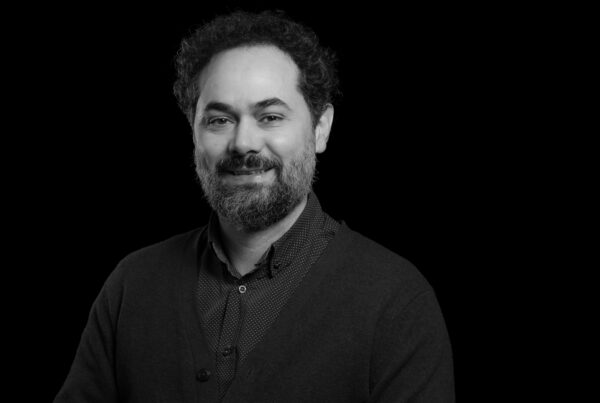
Diego Blas Temiño

Diego Blas Temiño

Institut de Física d'Altes Energies

Experimental Sciences & Mathematics

I was born in Burgos (Spain), but spent my early years in the scenic village of Benasque. I graduated in Physics from the Universidad de Zaragoza (2002), and moved to the Universitat de Barcelona for my PhD. During my thesis I focused on alternatives to General Relativity to try to alleviate the cosmological constant problem.

In 2008 I moved to EPFL, Switzerland were I developed theories of quantum gravity without Lorentz invariance and CLASS, a computer code widely used in modern cosmology. After few months in NYU, I moved to CERN in 2012, first as Senior Fellow and in 2014 as Staff Member. In this period, I widened my research towards analytical methods for large scale structure and new ideas to test dark matter models in astrophysics and precise (quantum) devices.

In 2018 I joined King's College London as Senior Lecturer and in 2021 the Universitat Autònoma de Barcelona and IFAE as Beatriz Galindo Distinguished Researcher. I was appointed ICREA Research Professor in 2023.

Research interests

Astrophysical probes of dark matter and gravitational waves
I look for new ways to use astrophysical data (from the timing of pulsars, to galactic dynamics, or the orbit of the Moon) to find new information about dark matter and gravitational waves.
New developments in gravitational wave searchers
I am part of the LISA Consortium, associated to the LISA Mission, and led the dark matter studies since 2019. I am also part of the Einstein Telescope. I was founding member of the AION Collaboration and member of the ELGAR initiative, both aiming at searching for gravitational waves and dark matter with atomic interferometers.
(Quantum) precision technologies for fundamental physics.
I am very interested in using cutting-edge technology to detect fundamental backgrounds. I have studied atomic clocks, co-magnetometers, atomic interferometers and electromagnetic cavities for dark matter and gravitational waves. I am really excited to open new directions in this line.

Selected publications

- Inchauspé H, Gasparotto S, Blas D, Heisenberg L, Zosso J & Tiwari S 2025, 'Measuring gravitational wave memory with LISA', Physical review d, 111 - 4 - 044044.
- Abdalla, A et al. 2025, 'Terrestrial Very-Long-Baseline Atom Interferometry: summary of the second workshop', Epj quantum technology, 12 - 1 - 42.

Selected research activities

Talks at 13 conferences, including plenary at Recontres de Moriond 2025: Gravitation & Xplorer Symposium: Particle Physics on Tabletops (PPTT). 14 invited talks at research centers.
Publications. 8 articles published, 11 preprints, 1 published proceedings. Editor of collection of articles on LISA, Springer. Contributor to the NovaMoon ESA white paper.
Funding. SGR 2021, Coordinator. Leonardo BBVA 2024, PI. Consolidación Investigadora grant, PI. MICIU/AEI grant, co-PI. ERC-2024-SYG, co-PI. WIDERA-2023 HORIZON grant, co-PI.
Group Leader Astroparticle Physics and Cosmology, IFAE. WP Manager, AION Collaboration.
Member of
  • Executive Committee of C-PAN.
  • LISA Consortium Constituent Council.
  • Scientific Committee, Benasque Center for Science.
  • LISA Consortium, ELGAR Initiative, AION Collaboration, Einstein Telescope, FLASH Collaboration.
  • COST action CA21106, RITCE Network & Quantera II grant.
  • International Collaboration Board of TVLBAI proto collaboration
  • Executive Committee of GravNet collaboration
Lecturer at 2025 European School of High-Energy Physics, 3 master programs.
Visiting Scientist at CERN. External Collaborator: CAPA, U. Zaragoza.
Evaluator for ERC (external), Czech Science Foundation and Leverhulme Trust.
Examiner in 1 (2) PhD (master) thesis. 1 master thesis supervised.
Supervising 4 (1) PhD (master) students. 2 supervised PhD theses defended.
Organizer. BIG quarterly meetings; 5 scientific meetings, including Quantum Sensing meets Ultra-high Frequency Gravitational Waves, Mainz.
Mentor at LISA, BIST & IFAE programs.
Outreach. 3 outreach talks, 2 press interviews.